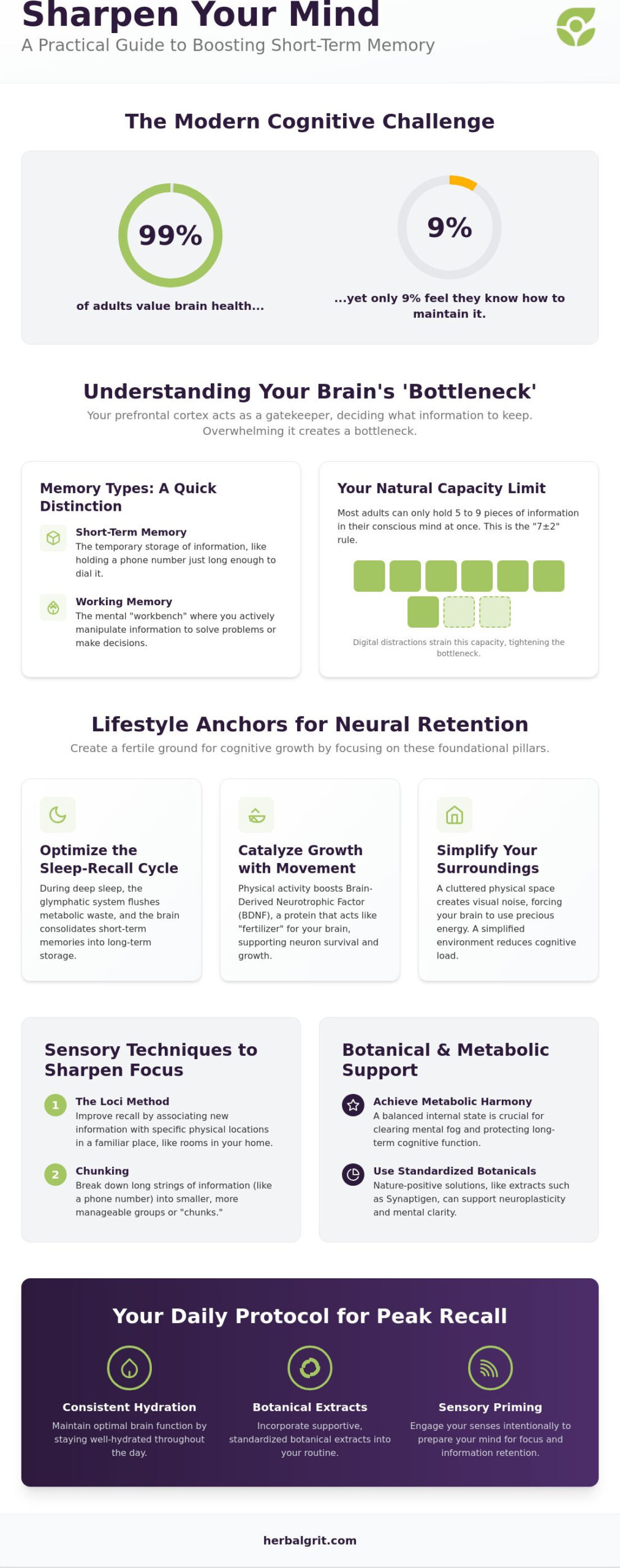
What if the mental fog you feel after a stressful meeting isn’t a sign of permanent decline, but a signal that your brain’s internal gating system is simply overwhelmed? It’s a frustrating reality in 2026, where 99% of adults value brain health, yet only 9% feel they truly know how to maintain it. If you’ve grown tired of generic advice like “just sleep more” while your daily recall remains hazy, you aren’t alone. Learning how to improve short term memory requires a more intentional approach that bridges the gap between modern science and the raw power of botanical wisdom.
You deserve to feel a sense of calm authority over your cognitive longevity. We agree that minor forgetfulness shouldn’t be a source of fear, but an invitation to nurture your mind more deeply. This guide promises to reveal the lifestyle shifts and sensory techniques that clear mental clouds and sharpen your focus instantly. We will explore how to achieve metabolic harmony and use nature-positive solutions to support long-term neuroplasticity, giving you back the control you need for a sharp, resilient mind.
Key Takeaways
- Learn the vital distinction between short-term and working memory to understand how your prefrontal cortex filters daily information.
- Explore how the “Sleep-Memory Axis” and physical movement naturally flush metabolic waste and boost essential brain-derived neurotrophic factors.
- Master practical sensory techniques, such as the Loci Method and chunking, to discover how to improve short term memory and sharpen your focus during meetings.
- Understand the role of standardized botanical supports and metabolic harmony in clearing mental fog and protecting long-term cognitive longevity.
- Establish a consistent daily protocol that combines hydration, botanical extracts like Synaptigen, and sensory priming for peak mental clarity.
Understanding the Short-Term Memory ‘Bottleneck’
Your brain isn’t a bottomless filing cabinet. It’s more like a curated gallery with limited wall space. The prefrontal cortex serves as the gatekeeper, deciding which sensory inputs deserve a spot and which should be discarded. By Understanding the Short-Term Memory ‘Bottleneck’, we can stop blaming ourselves for simple lapses and start working with our natural biology. This area of the brain is where we hold onto a phone number just long enough to dial it or remember a person’s name during a handshake.
It’s helpful to distinguish between short-term memory and working memory. While many use the terms interchangeably, they serve different roles in your daily life. Short-term memory is the temporary storage of information. Working memory is the “workbench” where you manipulate that information to solve a problem or make a decision. When you’re looking for how to improve short term memory, you’re often actually trying to strengthen the bridge between these two functions so your brain doesn’t feel so crowded. In demanding fields like finance, utilizing the SPX to SPY Converter to handle strike price translations is a practical way to achieve this, offloading technical data so your working memory can focus on strategic analysis.
Our capacity is naturally limited by what psychologists call the “7±2” rule. Most adults can only hold between five and nine pieces of information in their conscious mind at once. In 2026, the constant hum of digital notifications and rapid-fire content delivery is physically straining this capacity. This modern distraction doesn’t just annoy us; it fragments our attention and makes the “bottleneck” even tighter by forcing the prefrontal cortex to process a relentless stream of low-value data.
Why Your Brain ‘Drops’ Information
The hippocampus is the primary architect of your memories, responsible for encoding new data before it’s sent to long-term storage. However, this process is fragile. When you attempt to multitask, you create “interference.” This happens when new, irrelevant information pushes out the data you actually wanted to keep. The cognitive bottleneck is the primary obstacle to daily recall, acting as a narrow passage where competing thoughts often collide and vanish.
Identifying the Signs of Cognitive Fatigue
Cognitive fatigue often shows up in subtle ways. You might forget a colleague’s name seconds after an introduction or find yourself standing in a room wondering why you walked in. These aren’t necessarily signs of permanent decline; they’re often red flags that your mental gatekeeper is exhausted. Distinguishing these stress-induced gaps from more serious early signs of memory problems is a vital step in your wellness journey. Understanding how to improve short term memory starts with recognizing when your brain is simply asking for a restorative pause and a return to sensory alignment.
Lifestyle Anchors: The Foundation of Neural Retention
To build a resilient mind, we must look beyond mental puzzles and address the physical environment where our neurons live. Adopting specific Lifestyle Anchors for Neural Retention creates a fertile ground for cognitive growth. While the prefrontal cortex manages the immediate flow of data, your lifestyle determines whether that data takes root or withers away. Physical movement, for instance, acts as a powerful catalyst for Brain-Derived Neurotrophic Factor (BDNF). This protein supports the survival of existing neurons and encourages the growth of new ones, essentially acting like fertilizer for your brain’s internal garden.
Engaging in meaningful conversation provides a unique form of “cross-training” for your synapses. It requires you to listen, process, and respond in real-time, which keeps the neural pathways flexible and alert. Similarly, the organization of your physical space plays a quiet but vital role in how to improve short term memory. When your external environment is cluttered, your brain must use precious energy to filter out visual noise. Simplifying your surroundings reduces this internal cognitive load, leaving more room for the things you actually want to remember.
Optimizing the Sleep-Recall Cycle
Sleep is the time when your brain performs its most essential housekeeping. The glymphatic system, a specialized waste clearance pathway, becomes highly active during deep rest to flush out metabolic debris that accumulates during the day. If your REM cycle is frequently interrupted, your brain struggles to consolidate short-term memories into long-term ones. For those finding it difficult to reach these restorative depths, using a supportive tool like YU SLEEP can help bridge the gap to the profound rest your memory requires.
Cortisol: The Memory Killer
Chronic stress is one of the most significant barriers to mental clarity. When you’re under constant pressure, your body floods the brain with cortisol. High levels of this hormone can actually inhibit the hippocampus, the very center responsible for encoding new information. This phenomenon, often called “stress-induced amnesia,” can make you feel as though your mind is failing when it’s actually just overwhelmed. Understanding how stress causes short-term memory loss is the first step toward reclaiming your clarity. As you realign your daily habits, you may find that sensory support can accelerate your progress. Using a specialized protocol like The Brain Song can help harmonize your neural rhythms while you implement these foundational lifestyle shifts.
5 Sensory Techniques to Improve Focus and Recall
While lifestyle anchors provide the soil, sensory techniques are the tools that help you harvest clarity in the moment. Engaging multiple senses creates a richer, more durable neural trace. The Loci Method, often called the Memory Palace, invites you to place new information within a mental map of a familiar room. By visualizing a list of tasks along your hallway, you anchor abstract facts to stable spatial memories. This ancient practice remains one of the most effective ways to bypass the natural “bottleneck” of the prefrontal cortex.
Chunking is another essential strategy. It involves grouping complex strings of data into three or four meaningful units. For example, a ten-digit number is nearly impossible to hold in the mind as individual digits, but it becomes manageable when broken into smaller groups. This technique directly addresses how to improve short term memory by working within the brain’s natural capacity limits. When you combine this with dual encoding, which is the practice of pairing a visual image with an auditory cue, you essentially double your retention rates. These methods are foundational elements of a Daily Protocol for Peak Recall that anyone can master with consistent practice.
The “Vocal Loop” provides an immediate boost to daily focus. Simply saying a task out loud as you do it engages the motor cortex and the auditory system simultaneously. This makes the action three times harder to forget than if you had only thought about it. Finally, sensory synchronization uses specific audio frequencies to prime your brain for high receptivity. This is a vital tool in 2026, helping you filter out the noise of a digital world that often leaves us feeling fragmented and forgetful.
Active Listening and the ‘Paraphrase’ Hack
Most of us stop listening the moment we start planning our response. To counter this, use the “Echo Technique” during conversations. Briefly paraphrase what you’ve heard before you speak. This forces your brain to encode the information and locks in names or dates that might otherwise slip away. A simple three-second pause before you respond can be the difference between a fleeting thought and a lasting memory.
Brainwave Activation and ‘The Brain Song’
Your brain operates at different frequencies depending on your state of mind. Alpha waves are associated with relaxed focus, while Theta waves occur during deep receptivity and creative insight. Specific audio patterns can “entrain” your brain, guiding it into these healthy states for better learning. To experience this firsthand, you can integrate The Brain Song into your morning routine. This twelve-minute daily audio protocol is designed to activate these beneficial patterns, helping you start your day with a sense of grounded cognitive alignment.
Botanical Synergy: The Modern Apothecary’s Approach
While sensory techniques provide immediate relief, long-term cognitive clarity requires a deeper look at your brain’s internal environment. We must move beyond simple suggestions like “eat more blueberries” and embrace the precision of standardized botanical extracts. These concentrated natural solutions work to protect delicate synapses from oxidative stress and inflammation, ensuring your neural pathways remain clear. By reducing the “noise” of daily stress, adaptogens allow the “signal” of your memory to come through with greater strength and precision. This approach doesn’t just mask symptoms; it nurtures the very architecture of your mind.
Your brain’s metabolic state is a frequently overlooked factor in how to improve short term memory. When your system is flooded with glucose from heavy carbohydrate intake, it often leads to a sluggish “brain fog” that acts as a direct inhibitor to recall. Transitioning your brain to a cleaner, keto-like fuel source can provide a steady stream of energy without the peaks and valleys of sugar metabolism. This metabolic harmony supports the prefrontal cortex, allowing it to act as a more efficient gatekeeper for incoming data. It’s about providing the high-quality fuel your neurons need to communicate without interruption.
The Metabolic Brain: BioVanish and Recall
If you’ve ever felt a mental dip after a large meal, you’ve experienced how metabolic shifts impact your focus. Mimicking a ketogenic state allows the brain to utilize fats for fuel, which many find leads to a sharper, more resilient attention span. For those who find strict dieting difficult or unrealistic to maintain, a supportive tool like BioVanish can help facilitate this metabolic transition. It provides a gentle way to nurture your brain’s energy needs while clearing the fog that often clouds daily recall. When your metabolism is aligned, your memory has the endurance to last throughout the most demanding days.
Synergistic Nootropics for Clarity
Modern cognitive science in 2026 has confirmed the traditional wisdom of botanicals like Bacopa Monnieri and Gingko Biloba. These plants work in tandem to support blood flow and neurotransmitter function, creating a fertile environment for memory retention. Synaptigen is a cutting-edge brain health formula that brings these elements together in a balanced, nature-positive way. It’s a foundational step for anyone exploring how to improve short term memory through authentic, botanical solutions. To further enhance this restorative routine, you can integrate The Brain Song to align your neural rhythms with your new nutritional foundation, creating a complete ecosystem for mental clarity.
Your 2026 Daily Protocol for Peak Recall
A disciplined wellness routine is the bridge between the raw power of nature and your modern need for focus. To see real changes in your cognitive clarity, you must move from sporadic efforts to a steady, organized rhythm. This protocol integrates everything we’ve discussed, from metabolic harmony to sensory synchronization, into a simple daily flow. By following these steps, you learn how to improve short term memory through the steadfastness of a grounded lifestyle rather than the fleeting intensity of stimulants.
- Step 1: Morning Hydration and Botanical Support. Start your day with sixteen ounces of room-temperature water to rehydrate your neurons. This is the ideal time to introduce Synaptigen, providing your brain with the botanical synergy it needs to protect synapses and support blood flow from the moment you wake up.
- Step 2: 12 Minutes of Sensory Priming. Before you check your digital notifications, engage in a twelve-minute session with The Brain Song. This audio protocol uses specific frequencies to guide your brain into a state of high receptivity, preparing your “gatekeeper” for the incoming data of the day.
- Step 3: The Single-Tasking Work Block. Dedicate your first ninety minutes of work to one single task. By eliminating the cognitive bottleneck of multitasking, you allow your prefrontal cortex to process information deeply, which is a foundational secret of how to improve short term memory in a distracted world.
- Step 4: Evening Glymphatic Support. As the sun sets, shift your focus to restoration. Using a tool like YU SLEEP ensures you reach the deep REM cycles required for the glymphatic system to flush out metabolic waste and consolidate your daily memories.
The 12-Minute Mental Reset
Integrating audio brainwave activation into a busy schedule doesn’t require a total lifestyle overhaul. You can listen during your morning commute or while preparing breakfast. The cumulative effect of daily sensory synchronization creates a resilient neural environment that resists the fragmentation of modern life. Consistency in neural priming is more effective than occasional cognitive intensity. This gentle, daily alignment builds the long-term neuroplasticity needed for lasting recall.
Tracking Your Progress
Change often happens in subtle, restorative shifts. To measure your improvements, try the “Key and Phone” test over a thirty-day window. Simply track how many times a week you experience a “micro-forgetfulness” moment, such as misplacing your keys or losing your phone. As your metabolic and sensory health improves, you’ll likely notice these instances becoming rare. For more guidance on structuring your day for health, explore our daily supplement routine guide. This journey toward clarity is about reclaiming control over your cognitive longevity, one intentional step at a time.
Reclaiming Your Mental Horizon
Reclaiming your focus and learning how to improve short term memory isn’t just about trying harder; it’s about providing your brain with the restorative environment it needs to thrive. We’ve explored how addressing the cognitive bottleneck through single-tasking and metabolic alignment can clear the fog that often clouds daily life. By integrating sensory techniques with standardized botanical support, you give your prefrontal cortex the resilience required to filter information with ease. These small, intentional shifts create a foundation for lasting cognitive health and mental endurance. For those looking to apply this sharpened focus to professional success, MG Affiliate provides high-impact business and financial resources designed for peak performance.
Ready to activate your mind’s full potential? Discover The Brain Song and sharpen your recall today. This non-invasive audio technology is rooted in 2026 neuroscience protocols and supports natural BDNF production to help you maintain clarity throughout the day. It’s a gentle yet powerful way to align your neural rhythms with your wellness goals without the need for harsh stimulants. Your journey toward cognitive longevity is a path of steady, nurturing progress. Trust in the inherent strength of your mind and the power of these natural solutions to guide you forward with confidence.
Frequently Asked Questions
Is short-term memory loss a normal part of aging?
Slight changes in processing speed are a natural part of the aging process, but significant memory gaps that disrupt your daily routine are not. Most people notice a minor decline in cognitive flexibility as they get older. If you’re looking for how to improve short term memory, focus on lifestyle anchors and sensory priming. These proactive steps help maintain the resilience of your neural pathways well into your later years.
Can certain foods cause immediate brain fog and memory issues?
Yes, foods high in refined sugars and simple carbohydrates can trigger immediate brain fog by causing rapid fluctuations in blood glucose. This metabolic instability prevents the brain from accessing a steady, clean fuel source. Over time, these spikes inhibit the prefrontal cortex’s ability to gate information correctly. Opting for nutrient-dense fats and proteins supports the metabolic harmony necessary for sharp, consistent recall throughout the day.
How long does it take for brainwave audio like The Brain Song to work?
Most users experience a sense of sharpened focus after their very first twelve-minute session with The Brain Song. However, the most profound changes in recall and mental clarity typically emerge after thirty days of consistent use. This cumulative effect occurs because the audio frequencies help entrain your brain into states of high receptivity. Regular neural priming is the key to moving beyond fleeting focus into sustained cognitive endurance.
Are there any supplements that actually improve memory recall in 2026?
Standardized botanical extracts like Bacopa Monnieri and Gingko Biloba have shown significant support for cognitive function in 2026 research. Formulas like Synaptigen are specifically designed to provide these raw ingredients in a balanced, synergistic way. These supplements work by protecting synapses from oxidative stress and supporting healthy blood flow. When combined with a disciplined wellness routine, they offer a nature-positive approach to enhancing your daily mental performance.
What is the difference between short-term memory and dementia?
Short-term memory issues are often temporary bottlenecks caused by stress or fatigue, whereas dementia is a progressive decline that impacts multiple areas of daily living. While 11% of Americans aged 65 and older have Alzheimer’s in 2026, many younger adults simply suffer from cognitive fatigue. Understanding the difference helps you take the right steps. If you’re concerned about how to improve short term memory, starting with sensory and metabolic support is an excellent proactive measure.
Can drinking more water help with my focus and memory?
Proper hydration is essential for focus because the brain is composed of approximately 75% water. Even mild dehydration can lead to a measurable decrease in cognitive processing speed and short-term retention. When you’re dehydrated, your brain tissue can actually shrink slightly, making it harder for neurons to communicate. Drinking at least sixteen ounces of water upon waking is a simple but vital step for morning mental priming.
Does multitasking actually damage my short-term memory permanently?
Multitasking doesn’t necessarily cause permanent physical damage, but it does create a state of chronic interference that mimics memory loss. By constantly switching tasks, you never allow your hippocampus to deeply encode information. This habit fragments your attention span and exhausts the prefrontal cortex. Breaking the multitasking cycle is one of the fastest ways to reclaim your natural ability to hold and process new data without feeling overwhelmed.
How many hours of sleep do I need for my memory to function correctly?
Most adults require between seven and nine hours of quality sleep to ensure proper memory consolidation. During this time, the glymphatic system flushes out metabolic waste that accumulates during your waking hours. If you consistently get less than seven hours, your brain struggles to move short-term data into long-term storage. Prioritizing deep rest is perhaps the most foundational requirement for maintaining a sharp mind and preventing stress-induced memory gaps.