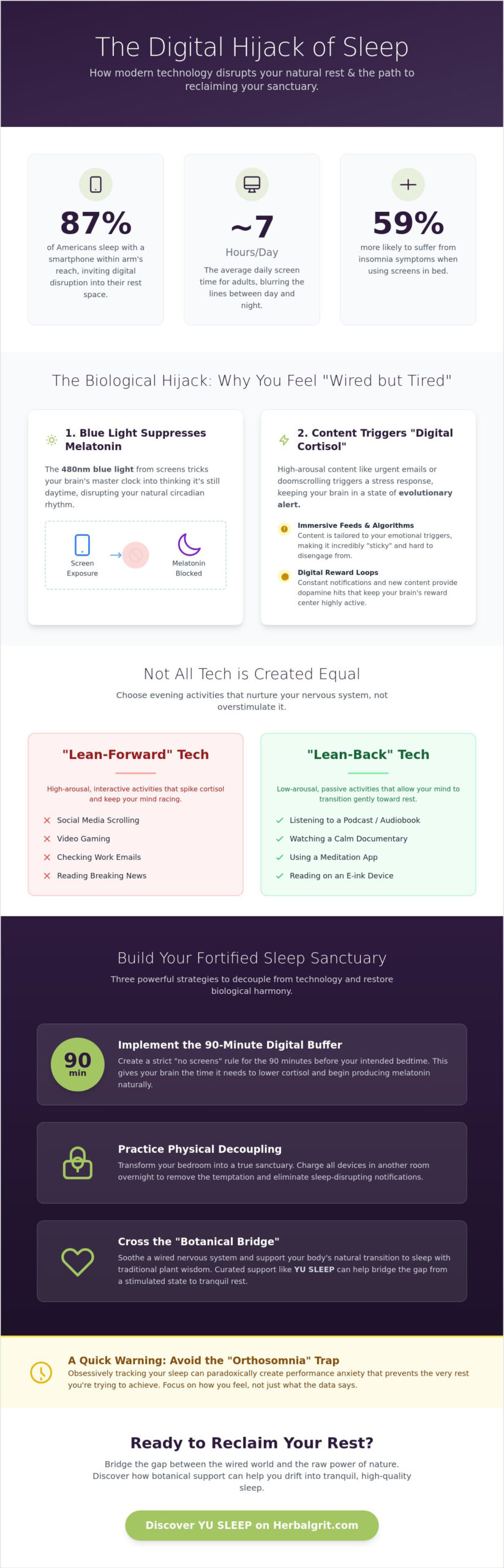
Did you know that 87% of Americans now sleep with a smartphone within arm’s reach, unknowingly inviting a digital hum into their most sacred space? In 2026, the average adult spends nearly seven hours staring at screens daily. This habit is more than a distraction; a 2025 study in Frontiers in Psychiatry found that using screens in bed makes you 59% more likely to suffer from insomnia symptoms. It is exhausting to wake up feeling unrefreshed, your mind still heavy with the racing thoughts of a late-night scroll. You aren’t alone in feeling that modern devices have hijacked your biology, leaving you with digital eye strain and a restless spirit.
We want to help you understand exactly how technology affects sleep quality so you can reclaim the deep, restorative rest your body craves. You deserve a sanctuary that feels grounded and peaceful. This guide explores why screens keep your brain in a state of evolutionary alert and offers a clear path to faster sleep onset. We will show you how to build a sustainable evening ritual that bridges the gap between the wired world and the raw power of nature. Discover how to settle your nervous system and use botanical support like YU SLEEP to finally drift into a tranquil, high quality REM sleep.
Key Takeaways
- Understand why modern algorithms and 480nm blue light wavelengths trigger “digital cortisol,” and how technology affects sleep quality by disrupting your internal clock.
- Differentiate between “lean-forward” and “lean-back” technology to choose evening activities that nurture your nervous system rather than overstimulating it.
- Guard against the “orthosomnia” trap where obsessive sleep tracking paradoxically creates the very anxiety that prevents restorative rest.
- Implement the 90-minute digital buffer rule and physical decoupling strategies to transform your bedroom into a fortified sanctuary of tranquility.
- Explore the “botanical bridge” concept to soothe a wired nervous system through traditional plant wisdom and curated support like YU SLEEP.
The 2026 Sleep Crisis: How Technology Affects Sleep Quality Today
The year 2026 has introduced a unique form of exhaustion often described as being “wired but tired.” You might find yourself physically drained after a long day, yet your mind continues to hum with the residue of a thousand short-form videos and personalized notifications. This isn’t just a matter of willpower. It’s a direct result of how modern technology is engineered. Understanding how technology affects sleep quality requires us to look beyond the brightness of the screen and examine the “always-on” culture that has effectively erased the boundary between day and night. We no longer have a natural winding down period; instead, we remain tethered to a digital world that never sleeps.
In this environment, Digital Rest has become a vital biological requirement. It’s the intentional act of disconnecting to allow the nervous system to return to its baseline. Without it, the brain remains in a state of high alert, processing information long after the device is put away. This constant connectivity erodes our ability to enter deep, restorative states of sleep, leading to a cycle of chronic fatigue and mental fog that many people now accept as normal. We must recognize that our biology isn’t designed for 24/7 stimulation.
The Evolution of Digital Interference
Technology has evolved from static, predictable media into something far more invasive. A decade ago, we might’ve watched a television program and then turned it off. Today, our mobile feeds are powered by sophisticated algorithms that predict exactly what will keep us watching. This makes 2026 technology significantly “stickier” than older devices. The brain struggles to switch off because every swipe offers a fresh hit of dopamine. This evolution has fueled a rise in bedtime procrastination. We find ourselves caught in a loop of digital rewards, sacrificing our health for just one more minute of engagement.
- Immersive Feeds: Content is now tailored to your specific emotional triggers, making it harder to walk away.
- Predictive AI: Your device knows when you’re likely to stop and serves a “must-see” post to keep you tethered.
- Digital Reward Loops: The constant stream of notifications keeps the brain’s reward center active well into the night.
Why Sleep Hygiene is No Longer Enough
Many of us have tried the standard advice: dim the lights, keep the room cool, or use a sleep mask. While these are good steps, they often fail because they don’t address mental hyperarousal. You can lie in a perfectly dark room, but if your mind is still racing from a high-arousal social media debate, sleep will remain elusive. This mental stimulation directly interferes with your circadian rhythm, the delicate internal clock that manages your sleep-wake cycles. Simply turning off the lamp doesn’t turn off the brain. We need to move toward a more holistic, nature-based recovery that treats rest as a sacred transition rather than a light switch we flip at midnight. True tranquility requires calming both the eyes and the mind.
The Biological Hijack: Blue Light, Melatonin, and Digital Cortisol
The biological impact of our devices goes far beyond simple eye strain. When we look at a screen, we expose our eyes to specific 480nm blue light wavelengths that communicate directly with the suprachiasmatic nucleus. This part of the brain acts as our master clock, regulating the timing of our physical and mental processes. In a natural environment, the fading evening sun signals the body to prepare for rest. However, the artificial glow of a phone tricks the brain into thinking it’s still midday. Research from Harvard Medical School has shown that this exposure suppressed the secretion of melatonin, which is the vital “hormone of darkness.” Without this chemical signal, the transition into sleep becomes a struggle against our own biology.
It isn’t just the light that causes trouble; the content we consume plays a massive role in how technology affects sleep quality. When you engage in “doomscrolling” or read an urgent work email at 11 PM, you trigger a spike in digital cortisol. This is a survival-based stress response that keeps your body in a state of high alert. Your brain doesn’t distinguish between a predatory threat in the wild and a stressful headline on your feed. This is coupled with a dopamine loop where the algorithm provides just enough novelty to make one more video feel like a biological necessity. You’re left in a state of hyperarousal that makes true tranquility almost impossible to achieve.
Circadian Rhythm Disruption
Our bodies operate on a delicate 24-hour cycle that dictates everything from body temperature to hunger. The circadian rhythm is the body’s internal conductor of health. When we use technology late into the night, we shift our “phase response curve,” essentially pushing our natural sleep window later and later. This leads to “social jetlag,” where your internal clock is permanently out of sync with your daily responsibilities. Over time, this disruption can weaken your resilience and leave you feeling perpetually ungrounded and unrefreshed, even after a full night in bed.
The Stress Response and Sleep Architecture
This tech-induced stress doesn’t just make it hard to fall asleep; it actively degrades the quality of the rest you do get. High levels of cortisol fragment your sleep architecture, reducing the time spent in vital Deep Sleep and REM stages. This is why a late-night work session often leads to a 3 AM wake-up call where your mind is suddenly racing. This physiological stress is closely linked to your metabolic support systems, as your body struggles to repair itself overnight. To bridge this gap between digital noise and natural rest, many find that a gentle, botanical solution like YU SLEEP helps quiet the mental chatter and restore biological harmony.
Active vs. Passive Technology: Comparing Different Digital Impacts
Not every glowing screen carries the same weight when it comes to your evening rest. While we have explored the biological mechanisms of light, the way you interact with a device is often the deciding factor in how technology affects sleep quality. We can categorize these interactions into “lean-forward” and “lean-back” technology. Lean-forward tech includes activities like gaming or engaging on social media; these require active cognitive participation and trigger frequent dopamine releases. In contrast, lean-back tech like an e-reader or a calm podcast allows the mind to drift into a more passive state. While the light from an e-reader still exists, the mental “arousal level” is significantly lower, making it a gentler companion for your wind-down routine.
Blue light filters have become a popular tool for those who cannot step away from their screens. While these software adjustments can soften the impact of 480nm wavelengths, they often provide a sense of false security. A filter might reduce the strain on your eyes, but it cannot stop the cognitive stimulation caused by a stressful news feed or an immersive video. Relying solely on a filter ignores the mental hyperarousal that keeps your brain awake long after the screen is dark. True digital rest requires us to look beyond the color of the light and consider the emotional weight of the content itself.
The Hierarchy of Digital Harm
In the digital landscape of 2026, the “Infinite Scroll” is perhaps the most disruptive force for our evening peace. Unlike a digital book or an episodic show that has a clear ending, social media platforms are designed to be bottomless. This lack of a stopping point fuels bedtime procrastination, as the brain is constantly promised one more hit of novelty. To protect your rest, it is helpful to categorize your devices by their arousal level. A digital book is a low-arousal tool, while a high-speed competitive game sits at the top of the hierarchy, demanding a state of “evolutionary alert” that is the direct opposite of what your body needs for sleep.
When Technology Tries to Help: Sleep Tech Pros and Cons
There is a curious paradox in using an app to solve a problem that technology created. The May 2026 release of the Oura Ring 5 has introduced advanced features like “Health Radar” and “Live Activity Tracking.” While these tools provide incredible insights into our nighttime breathing and blood pressure, they have also fueled a phenomenon known as “orthosomnia.” This is an unhealthy obsession with achieving perfect sleep data. The irony is that the anxiety of checking your “sleep score” can lead to disrupted Circadian Rhythms, as the pressure to perform at night keeps the nervous system on edge.
Instead of relying on another screen to monitor your rest, consider returning to more traditional, grounded solutions. While white noise machines can be helpful, phone-based apps often bring notifications along with their soothing sounds. Stepping away from the data and leaning into a botanical solution like YU SLEEP can help bridge the gap between a wired mind and a peaceful body. By quieting the internal noise, you can move away from the pressure of “perfect” scores and return to the natural, unhurried rhythm of deep sleep.
Building a Fortified Sleep Sanctuary: Actionable Digital Detox Strategies
Reclaiming your rest requires more than just a firm mattress or the ergonomic support of Gurum Pillow; it demands a physical and mental boundary between your digital life and your biological needs. To truly understand how technology affects sleep quality, we must treat the bedroom as a fortified sanctuary. This starts with the 90-Minute Rule. By creating a digital buffer zone ninety minutes before your head hits the pillow, you allow your nervous system to transition from high-alert processing to a state of natural tranquility. This period is for the soul to settle, away from the relentless hum of notifications and algorithmic demands.
Physical decoupling is the most effective way to enforce this boundary. Despite the fact that 87% of Americans sleep with their phones in the bedroom, your device is a portal to the “Always-On” culture we discussed earlier. Moving the phone to another room removes the temptation of a 3 AM scroll and eliminates the subtle anxiety of a pending notification, while also aligning with the principles of Radiation-Free Living by reducing environmental stressors in your sleeping area. Replace the digital glow with analog alternatives. A manual alarm clock, a paper journal, and a physical book offer tactile rewards that don’t trick your brain into thinking it’s daylight. These simple tools ground you in the present moment rather than pulling you into a virtual future.
The Evening Wind-Down Protocol
A successful transition into sleep is a ritual, not a sudden event. Start by powering down the main lights in your home, favoring dim, warm lighting that signals safety to the brain. Incorporate a “Brain Dump” into your routine; spend five minutes writing down every racing thought or to-do list item on paper. This physical act offloads mental baggage, preventing the “wired” feeling that keeps you awake. When you master this protocol, you will likely find it easier to feel sharper at work because your brain has actually completed its nightly repair cycles.
Tech-Friendly Compromises
If your circumstances require some level of evening connectivity, use strategies that minimize the harm. Switch your device to grayscale mode to strip away the dopamine-inducing colors of social media. Use “nuclear” app blockers that cannot be easily bypassed after 9 PM. In your living spaces, replace standard LEDs with red-shifted light bulbs, which are far less disruptive to your internal clock. While these are helpful adjustments, they are secondary to the goal of total digital rest. To support this transition and soothe a nervous system that has been overstimulated by screens, consider adding YU SLEEP to your evening ritual. It acts as a botanical bridge, helping you reclaim the deep, restorative rest you deserve.
Restoring Biological Harmony: The Botanical Bridge to Deep Sleep
While establishing a digital detox routine is essential, simply turning off your phone doesn’t always turn off the internal hum of a “wired” nervous system. If you have spent years immersed in high-arousal digital environments, your body may have forgotten how to settle on its own. Silence alone isn’t always enough to reset a mind that is still processing the remnants of digital cortisol. To truly address how technology affects sleep quality, we need to offer the body a botanical bridge that guides the nervous system back to its natural baseline of tranquility.
Adaptogens and nervines act as gentle anchors for a mind adrift in digital noise. These traditional plant solutions work with your biology to counteract the physiological stress responses triggered by late-night scrolling and constant connectivity. By combining these natural elements with your new digital boundaries, you create a holistic environment where restorative sleep isn’t just a goal; it’s a biological certainty. This transition requires a nurturing approach that respects the raw power of nature’s ingredients to heal what technology has disrupted.
Nurturing the Nervous System
The path to deep rest often involves soothing the nervous system with time-tested botanicals like Valerian root and Passionflower. These ingredients, along with essential minerals like Magnesium, help the brain transition from the high-frequency “Beta” waves of active work and digital engagement into the slower “Theta” waves of relaxation. This shift is crucial for counteracting the hyperarousal caused by screens. For those looking to maintain cognitive health during the day, these rest-focused solutions work in perfect synergy with herbal supplements for focus and memory, ensuring your mind is sharp when needed and soft when it’s time to rest.
The YU SLEEP Advantage
For the modern consumer navigating the complexities of 2026 technology, YU SLEEP stands as the premier choice for reclaiming biological harmony. It is specifically formulated to address the “3 AM wake-up” call that often follows a day of heavy tech use and algorithmic overstimulation. By quieting the mental chatter and supporting the body’s internal clock, this targeted solution helps you move past the anxiety of orthosomnia and into a state of pure, unhurried rest. We encourage a 30-day “Digital and Botanical” reset. By pairing disciplined digital boundaries with the restorative power of YU SLEEP, you can experience life-changing clarity and wake up feeling truly refreshed. When selecting any botanical formula, understanding third-party testing for supplements ensures you can trust the purity and potency of what you’re putting into your body. This is where the steadfastness of a disciplined wellness routine meets the softness of botanical wisdom.
Reclaiming Your Natural Rhythm in a Digital Age
The path to deep rest in 2026 requires a conscious return to our biological roots. We have explored how modern algorithms and blue light wavelengths trigger a state of hyperarousal; it is clear that understanding how technology affects sleep quality is the first step toward healing. By establishing a 90-minute digital buffer and moving your devices out of the sanctuary of your bedroom, you create the space your body needs to transition from the hum of the wired world to the tranquility of the natural one.
Boundaries are essential, yet they are only half of the journey. For a nervous system that has been overstimulated by an “always-on” culture, a botanical bridge provides the necessary softness to fully let go. You can reclaim your nights with the YU SLEEP botanical formula. This natural, non-habit forming solution is specifically optimized for 2026 sleep trends and recognized for its high-performance results. It works in harmony with your new habits to help you move past the 3 AM wake-up call and into a state of restorative REM sleep. Trust in the raw power of nature to restore the biological harmony you deserve.
Frequently Asked Questions
Does ‘Night Mode’ on my phone actually improve sleep quality?
Night Mode reduces the intensity of blue light, but it’s not a complete solution for how technology affects sleep quality. While shifting to warmer tones is easier on your eyes, the device still emits light that can suppress melatonin. More importantly, it doesn’t address the mental stimulation of the content you’re viewing. A warm screen showing a stressful news feed still keeps your brain in a state of high alert and prevents deep rest.
How long before bed should I stop using all electronic devices?
You should ideally power down all electronic devices at least 60 minutes before you plan to sleep. The American Academy of Sleep Medicine recommends this window to allow your brain’s natural melatonin production to begin without interference. For those who find it particularly difficult to settle, extending this to a 90-minute digital buffer zone provides a more resilient boundary. This unhurried transition helps bridge the gap between digital noise and natural tranquility.
Can watching TV in bed be better for sleep than using a smartphone?
Watching television is generally less disruptive than using a smartphone because it’s a passive, lean-back activity. Smartphones are interactive and held close to your face, which increases blue light exposure and cognitive engagement. While a TV still emits light, the distance and lack of physical interaction often result in lower mental arousal. However, the best choice for restorative rest remains a completely dark, tech-free environment that follows your natural internal clock.
What are the long-term effects of technology on children’s sleep?
Technology can lead to chronic sleep deprivation in children if not managed with care. The American Academy of Pediatrics updated its guidelines in January 2026 to focus on the quality and context of screen use. For children under 18 months, the recommendation remains no screen time except for video chatting. Excessive use, especially in bed, disrupts developing circadian rhythms, potentially leading to long-term issues with focus, mood regulation, and emotional resilience.
Is it okay to use an e-reader like a Kindle before bed?
Using an e-ink reader is a much gentler option than a tablet or smartphone. These devices are designed to mimic paper and don’t typically use the high-intensity blue light found in backlit LCD screens. Because reading a book is a low-arousal activity, it helps the mind transition into a state of calm. Just ensure you’re using a device without a bright backlight to keep your internal clock steady and your spirit grounded.
How can I stop the habit of checking my phone if I wake up at night?
The most effective way to break this habit is to keep your phone in a completely different room. If the device isn’t within reach, you remove the temptation to check notifications during a 3 AM wake-up. This physical decoupling is a foundational part of how technology affects sleep quality management. Use a manual alarm clock instead so you aren’t reliant on a digital portal for your basic morning routine.
What are the best natural alternatives to pharmaceutical sleep aids?
Natural alternatives focus on nurturing the nervous system rather than forcing it into sedation. Traditional botanicals like Valerian root, Passionflower, and Magnesium are excellent for calming a wired mind. These ingredients support a gentle transition into rest without the risk of dependency. For those seeking a curated solution, YU SLEEP offers a targeted botanical formula designed to help you reset your biological harmony after a day of heavy digital engagement and mental noise. Before committing to any supplement, reviewing the standards of third-party testing for supplements can give you the confidence that what’s on the label is truly what’s in the bottle.
Can technology like white noise machines actually help me sleep better?
Yes, white noise machines can be a helpful tool for creating a stable auditory environment. By providing a consistent, soothing background hum, they mask disruptive sounds that might otherwise pull you out of deep sleep. This is a rare example of technology supporting rest. Just be careful to use a dedicated, analog-style machine rather than a phone app, as the latter often brings the risk of blue light and distracting late-night notifications.