What if the very pill you rely on for rest is actually preventing your brain from truly recovering? According to 2026 CDC data, nearly 13% of adults now use sleep aids most days, yet many remain unaware of the physiological side effects of long-term sleep aid use. You’ve likely felt the heavy morning fog or the growing worry that your body has forgotten how to drift off naturally. It’s a frustrating cycle where the solution starts to feel like a new problem, leaving you tethered to a bottle just to function.
We understand that your journey toward wellness should feel like a return to nature rather than a chemical dependency. This guide offers a clear look at the risks of chronic reliance and provides a science-backed roadmap to help you reclaim your body’s innate sleep-wake cycle. We’ll explore how to move away from sedation and toward genuine restoration; including a look at how curated botanical solutions like YU SLEEP can support a gentler, more sustainable path to rest without the lingering hangover of traditional aids.
Key Takeaways
- Understand the vital distinction between chemical sedation and restorative sleep to ensure your brain actually recovers overnight.
- Identify the physiological side effects of long-term sleep aid use, such as memory consolidation issues and the cycle of increasing tolerance.
- Compare the hidden risks of over-the-counter antihistamines and prescription Z-drugs, including complex sleep behaviors and cognitive decline.
- Learn a science-backed tapering roadmap to safely restore your natural sleep-wake cycle without the fear of worsening insomnia.
- Discover how botanical adaptogens and minerals can nurture your nervous system for deep, natural rest instead of simply muting your senses.
The Creeping Cost of Chemical Sleep: Understanding Long-Term Use
For many, the journey begins with one difficult night. A stressful deadline or a period of grief makes sleep feel impossible, and a small pill offers a welcome bridge to the morning. In 2026, medical guidance remains clear: these interventions are intended for acute relief, typically lasting no more than two to four weeks. However, the line between a temporary fix and a chronic habit often blurs before we realize it. When occasional use shifts into a nightly requirement, the body moves from seeking help to developing a reliance that alters its core chemistry.
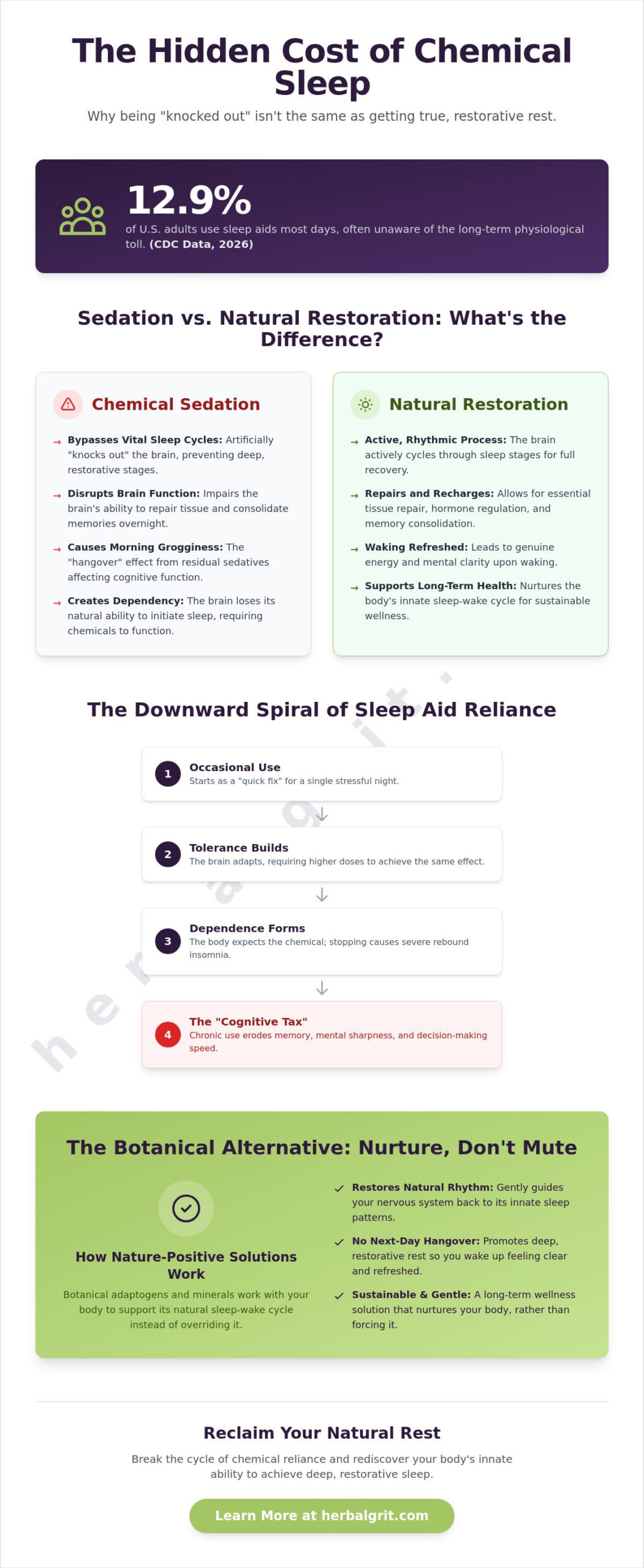
It’s vital to distinguish between sedation and true, restorative sleep. While chemical aids are highly effective at “knocking out” the brain, being unconscious is not the same as resting. Natural sleep is an active, rhythmic process where the brain cycles through stages to repair tissue and consolidate memories. Sedatives often bypass these delicate cycles, providing a state of quietude that lacks the biological depth of natural slumber. Sleep aid dependency is a state where the brain’s GABA receptors lose their natural sensitivity, requiring external chemicals to trigger the relaxation response that once happened on its own.
Despite increased awareness of the long-term effects of benzodiazepines and other sedatives, use remains at an all-time high. CDC data from April 2026 shows that 12.9% of adults in the U.S. use sleep aids most days or every day. This prevalence suggests a modern epidemic of “chemical sleep” that often ignores the underlying physiological toll.
The 2026 Sleep Paradox: Digital Stress and Pill Reliance
Our modern “always-on” culture has created a unique biological conflict. The pervasive blue light from high-definition displays and the constant stream of information keep our nervous systems in a state of high alert long after the sun sets. This digital stress prevents the natural rise of melatonin, leading many to reach for a pill as a manual “off switch.”
The habit is often fueled by a psychological safety net. The fear of a sleepless night and the subsequent daytime exhaustion becomes so intense that taking a pill feels like the only responsible choice. Eventually, we hit a tipping point. The aid that was supposed to solve your insomnia becomes a sleep obstacle, creating a barrier to the very natural rhythm your body is trying to restore.
Why “Short-Term” Solutions Become Long-Term Problems
The allure of immediate gratification often masks the long-term biological cost. When you use a sedative every night, your body’s homeostatic sleep drive—the internal pressure that builds up throughout the day to help you fall asleep—is suppressed. Your brain begins to expect the chemical intervention, leading to the side effects of long-term sleep aid use such as rebound insomnia and daytime grogginess.
The transition is subtle but profound. You move from “taking it to sleep” to “taking it to feel normal.” To break this cycle, it’s essential to look toward solutions that nurture the brain’s rhythm rather than muting it. Products like YU SLEEP focus on this restorative approach, helping to bridge the gap between chemical reliance and the tranquil, natural rest your body was designed for.
The Physiological Impact: Tolerance, Dependence, and the Cognitive Tax
The human brain is an incredibly adaptable organ, constantly seeking a state of equilibrium. When you introduce a sedative nightly, the brain doesn’t simply accept the help. It views the chemical intervention as an external force and begins to push back to maintain balance. This biological tug-of-war is the root of tolerance. Over time, your neural pathways become less sensitive to the medication, meaning the dose that once brought swift slumber eventually fails to work. You’re left chasing the same quietude with higher amounts, deepening the side effects of long-term sleep aid use without actually improving your rest.
This reliance creates what experts call a “Cognitive Tax.” While you might be unconscious for eight hours, your brain isn’t performing its essential nightly maintenance. Research into the residual effects of sleep medications reveals that chronic use often erodes executive function and memory consolidation. By 2025, clinical observations have increasingly linked prolonged sedative use to a measurable decline in mental sharpness and decision-making speed. It isn’t just morning grogginess; it’s a fundamental shift in how your brain processes information during the day.
The physical toll extends beyond the mind. Many users experience digestive disruption as the nervous system’s “rest and digest” mode is artificially manipulated. For older adults, the risks are even more direct. Sedatives can impair motor coordination and balance, significantly increasing the likelihood of falls and injuries during the night or early morning hours.
GABA Receptor Downregulation: The Brain’s Protective Misfire
To compensate for the constant presence of sleep aids, the brain “mutes” its own natural calming signals. This process, known as GABA receptor downregulation, means your body produces less of its own tranquilizing chemicals. When you skip a dose, your brain is left in a state of hyper-arousal because it has forgotten how to soothe itself. This is the chemical origin of “rebound insomnia,” where the inability to sleep becomes far worse than it was before you started the medication. It’s also why long-term users often report feeling more anxious or “on edge” during daylight hours.
The REM Sleep Deficit: Why You Wake Up Tired
Most pharmaceutical aids act as blunt instruments, forcing the brain into deep-wave sleep while often skipping the vital Rapid Eye Movement (REM) stage. REM is where emotional regulation and creativity are processed. When this stage is suppressed, you might wake up feeling physically still, but emotionally drained and mentally stagnant. During the recovery process, many experience a “REM rebound,” where the brain desperately tries to make up for lost time with vivid, intense, or even disturbing dreams as it attempts to rewire its natural architecture. If you find yourself waking in the night and struggling to return to these deeper stages, understanding how to fall back asleep after waking up can be a vital part of your recovery toolkit. Nurturing your body’s innate rhythms with a gentle solution like YU SLEEP can help you transition back to these restorative cycles without the harshness of synthetic sedatives.
Comparing Risks: OTC Antihistamines vs. Prescription Z-Drugs
When seeking a night of quietude, many people assume that a bottle from the drugstore aisle is inherently safer than a prescription from a clinic. In reality, both paths carry significant physiological weight. When exploring the side effects of sleeping pills, we see a divide between the “anticholinergic burden” of over-the-counter (OTC) options and the complex behavioral risks of prescription hypnotics. While the delivery method differs, the side effects of long-term sleep aid use remain a shared concern for those seeking sustainable, holistic wellness.
The “hangover effect” is perhaps the most immediate differentiator. OTC antihistamines often have long half-lives, meaning the sedation lingers well into the next afternoon, clouding your cognitive clarity. Prescription Z-drugs, like Zolpidem or Eszopiclone, are designed to exit the system faster, but they achieve this by more aggressively altering your brain’s architecture. Even synthetic melatonin carries a hidden risk. By flooding your system with external hormones, you may inadvertently signal your brain to shut down its own production, creating a cycle of endocrine dependency that is difficult to break. For those who find themselves regularly jolting awake in the early hours, understanding the causes of waking up at 3am every night reveals how these hormonal disruptions and metabolic feedback loops can compound the very sleep problems these aids are meant to solve.
The Hidden Dangers of “PM” Pain Relievers
Many consumers reach for “PM” formulations to address both minor aches and restlessness. This creates a double burden on the body. Combining analgesics like acetaminophen with sedating antihistamines places unnecessary stress on the liver and kidneys. Beyond organ health, the cumulative effect of daily diphenhydramine use is a growing concern for long-term brain health. These “hidden” sedatives are often found in multi-symptom cold medications, leading many to consume these chemicals without realizing they are contributing to a chronic habit.
Prescription Dependency: The Gold Standard Trap
Prescription hypnotics are often viewed as the gold standard for insomnia, yet they act as a blunt instrument against the brain’s delicate rhythms. These medications significantly suppress the stages of sleep required for emotional processing. A major safety milestone occurred in 2024 when the FDA implemented a boxed warning for certain prescription insomnia medications due to documented injuries from complex sleep behaviors. These parasomnias, such as sleep-walking or sleep-eating with no memory of the event, represent a profound disruption of the mind-body connection.
Choosing a path toward restoration requires understanding how these different chemicals interact with your biology. For those comparing modern options, our analysis of Roman Sleep Support vs YU SLEEP provides a detailed look at how botanical integrity compares to synthetic alternatives. Reclaiming your rest means moving away from the “gold standard trap” and toward solutions that nurture, rather than override, your natural sleep-wake cycle.
Restoring the Rhythm: A Roadmap to Breaking the Cycle
Breaking the cycle of chemical reliance is a journey of restoration rather than a test of willpower. Your body possesses an incredible capacity for healing, but it requires a gentle, structured approach to remember its natural rhythm. If you’ve been using sedatives for months or years, the most compassionate way to treat your nervous system is through a gradual taper. Stopping “cold turkey” is often a recipe for failure, as it triggers severe rebound insomnia. This sudden surge of wakefulness is one of the most distressing side effects of long-term sleep aid use, often leading people back to the bottle out of pure desperation. By slowly reducing your intake, you give your brain’s GABA receptors the time they need to regain their natural sensitivity.
During this transition, managing the “rebound period” requires cognitive reframing. Instead of viewing a night of light sleep as a failure, see it as your brain “re-learning” how to navigate the stages of rest. You can support this process by focusing on non-habit-forming botanical precursors that nurture the nervous system without overriding it. Tracking “rest quality”—how you feel upon waking—is far more important than simply counting the hours you spent unconscious. True recovery is measured by the return of your daytime vitality and mental clarity. For those looking to support their cognitive health during this time, exploring herbal supplements for focus and memory can help bridge the gap as your brain fog begins to lift.
Environmental Mastery: Optimising Your Sleep Sanctuary
In 2026, our homes are often flooded with invisible disruptors. To reclaim your rest, you must master your environment. Temperature regulation is vital; your body needs a drop in core temperature to initiate the “cooling effect” that signals sleep onset. Aim for a bedroom temperature between 16 and 18 degrees Celsius. Light management goes beyond just turning off the TV. Even the small LEDs on chargers can disrupt melatonin production. Use blackout curtains and consider a digital detox that begins at least 90 minutes before bed to shield your brain from the high-frequency dopamine loops of modern devices.
The Mindset Shift: Befriending Wakefulness
One of the biggest hurdles to natural rest is “sleep effort.” This is the paradoxical anxiety that occurs when you try too hard to force sleep to happen. The more you chase rest, the faster it runs away. Techniques like paradoxical intention—where you simply lie in the dark and “allow” yourself to be awake without judgment—can calm racing thoughts. By removing the pressure to perform, you lower your cortisol levels and create the tranquility necessary for sleep to arrive on its own terms. Those who regularly wake during the night and struggle to settle back down will find practical, science-backed strategies for how to fall back asleep after waking up especially useful during this phase of recovery. If you are ready to move away from synthetic sedatives and toward a nature-positive solution, you can discover how YU SLEEP supports your body’s innate transition into deep, restorative rest.
The Botanical Alternative: Why Nature-Positive Solutions Support Long-Term Wellness
The journey away from chemical dependency is not about finding a different way to knock yourself out. It’s about restoring the delicate biological dialogue that synthetic sedatives have silenced. While pharmaceutical aids act as blunt instruments, nature-positive solutions function as a gentle nudge, encouraging the body to resume its own restorative processes. By shifting your focus from sedation to support, you can successfully navigate the side effects of long-term sleep aid use and build a foundation for rest that feels truly earned rather than forced.
The primary difference lies in the use of adaptogens versus sedatives. Traditional sleep aids often work by overriding your nervous system, but adaptogens help your body nurture its own stress response. Instead of muting your brain, ingredients like L-Theanine and Magnesium act as precursors for natural GABA production. They prepare the neural landscape for tranquility without the risk of receptor downregulation. This approach creates a “Botanical Bridge,” where premium wellness resources like Rastaman Stew can support your journey, allowing you to taper off synthetic chemicals while providing your brain with the raw materials it needs to find its own way back to sleep.
Nurturing the Circadian Rhythm with YU SLEEP
Modern wellness requires a return to ancestral wisdom, which is why the YU SLEEP formula was designed to support the root cause of restlessness: a disrupted circadian rhythm. Rather than forcing an immediate state of unconsciousness, it encourages a natural evening transition that aligns with your body’s internal clock. The most significant benefit for many users is the complete absence of the “Hangover Effect.” Because these botanical elements are metabolized in harmony with your natural cycles, you wake up with genuine mental clarity and the vitality needed to face the day. For those ready to experience this shift, YU SLEEP – The #1 Sleep Offer provides a curated path toward sustainable rest.
Building Long-Term Resilience
True health is a holistic pursuit that doesn’t stop when you open your eyes in the morning. Rebuilding what chronic chemical use has eroded takes time and a multi-faceted strategy. You can achieve total cognitive harmony by combining evening botanical support with tools like The Brain Song, which focuses on restoring the memory and focus that often suffer during years of poor sleep quality. Consistency is the key to this transformation. Natural solutions require patience as they slowly repair the biological pathways that synthetic pills once bypassed. It’s time to stop settling for chemical sedation and start investing in your body’s inherent strength. Explore YU SLEEP for a safer, deeper rest today and reclaim the tranquil, restorative sleep you deserve.
Reclaiming Your Natural Rest
The journey back to natural rest is a path of patience and biological respect. You’ve learned how chemical sedation differs from true recovery and why a structured taper is the kindest way to treat your nervous system. By addressing the side effects of long-term sleep aid use through intentional lifestyle shifts and botanical support, you can rebuild the tranquility that synthetic pills once suppressed. Rest is not something to be forced; it’s a rhythm to be nurtured.
As you move forward, remember that your body is designed for restorative slumber. Choosing nature-positive, non-habit-forming ingredients allows you to bridge the gap between dependency and independence. The March 2026 update to our high-performance formula offers a gentle way to prepare your brain for natural GABA production without the heavy fog of traditional aids. It’s time to trust your body’s innate wisdom and return to the deep, refreshing sleep you were meant to have.
Experience Deep, Natural Rest with YU SLEEP – The #1 Botanical Sleep Solution. You deserve a morning that feels as bright as the night was calm.
Frequently Asked Questions
How long is too long to take a sleep aid?
Most medical guidelines suggest limiting sleep aids to two to four weeks for acute relief. Using them beyond this window transitions from temporary support to chronic reliance. When use extends into months or years, the body begins to adapt to the chemical presence, leading to the physiological side effects of long-term sleep aid use. It’s best to view these tools as a short-term bridge rather than a permanent solution for rest.
Can long-term use of sleeping pills cause permanent memory loss?
While “permanent” is a heavy word, chronic sedative use is documented to impair memory consolidation. This happens because many aids suppress REM sleep, the stage where your brain processes and stores the day’s information. Over time, this creates a “cognitive tax” that makes it harder to recall details or learn new skills. Restoring your natural sleep-wake cycle is the most effective way to help your brain regain its full processing power.
What is rebound insomnia and how long does it last?
Rebound insomnia is a surge of wakefulness that occurs when you stop taking a sedative your body has become accustomed to. It usually lasts between three days and two weeks, though the duration depends on how long you used the aid and how quickly you stopped. This period can be intense, as your brain’s GABA receptors are essentially re-learning how to function without chemical assistance.
Are natural sleep aids like melatonin safe for long-term use?
Melatonin and botanical extracts are generally considered safer than synthetic sedatives, but they aren’t without considerations. The FDA regulates these as dietary supplements rather than drugs, meaning their long-term effects aren’t always fully documented. Using synthetic melatonin nightly can sometimes signal your brain to reduce its own hormone production. Botanical precursors like those in YU SLEEP are designed to support, rather than override, your natural evening transition.
What are the early warning signs of sleep aid dependency?
The first sign of dependency is often tolerance, where the dose that once worked no longer provides the same relief. You might also notice a growing sense of anxiety as bedtime approaches if you don’t have your medication nearby. If you find it impossible to drift off without a pill, or if you feel a persistent “hangover” of daytime grogginess, your body is likely signaling a reliance on external chemicals.
How can I safely stop taking prescription sleep medication?
Safety requires a slow and steady reduction rather than an abrupt halt. A gradual taper allows your nervous system to adjust slowly, which minimizes the intensity of withdrawal symptoms. You should consult with a healthcare professional before changing your regimen for prescription medications. During this transition, implementing a digital detox and focusing on nature-positive lifestyle changes can help support your body’s return to natural rest.
Do sleep aids increase the risk of dementia or Alzheimers?
Research has indicated a link between the long-term use of certain OTC aids, specifically those with anticholinergic properties, and an increased risk of cognitive decline. While the data for prescription Z-drugs is still being studied, the documented side effects of long-term sleep aid use often include a measurable tax on executive function. Protecting your brain health means prioritizing restorative, natural sleep cycles that allow for proper neural repair.
Can I switch directly from a prescription pill to a botanical supplement?
A direct switch is often difficult because botanical supplements don’t provide the same immediate “knockout” effect as prescription sedatives. Instead, think of botanicals as a supportive bridge. They work best when introduced during a gradual taper to help soothe the nervous system as you reduce your pharmaceutical intake. This allows your body to slowly rebuild its innate sleep-wake rhythm without the shock of a sudden chemical absence. If you find yourself waking consistently in the small hours despite your best efforts, exploring the causes of waking up at 3am every night can help you identify the underlying hormonal and metabolic signals that botanicals are uniquely positioned to address.